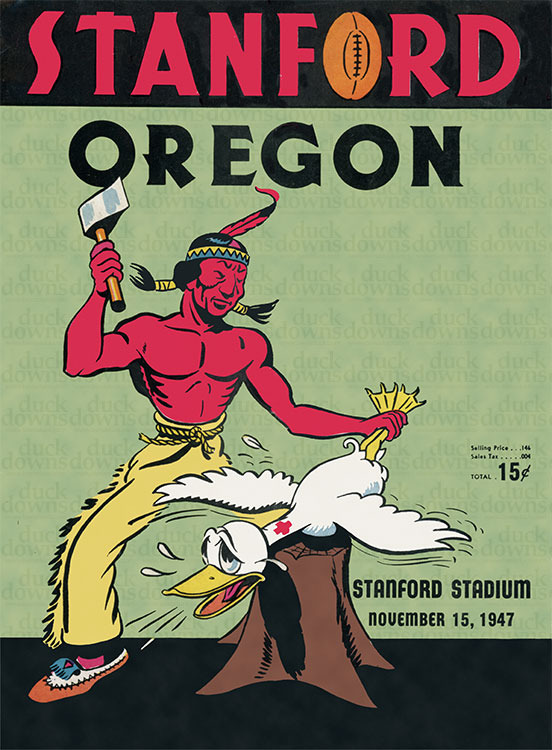
November 9, 1935 -- OSC at Oregon
January 28, 2012 Click here for the latest entry in the Program Project, the 1935 Civil War.
And if Luckies weren’t your style…
“Broadcasting” the 1917 Rose Bowl
December 26, 2011 Ever wonder how fans back home followed an away football game as it was being played back in the day?
Consider that KDKA, the nation’s first radio station, didn’t begin broadcasting from the Westinghouse factory in Pittsburgh until November of 1920, and the first football game broadcast – West Virginia at Pitt – wasn’t until October of 1921. It didn’t take long for the new medium to explode in popularity, but the Rose Bowl wasn’t broadcast nationally until the 1927 game pitting Alabama and Stanford.

Guy with a megaphone.
Without a play-by-play, or a knowledgeable sidekick explaining the action on the field, what was a fan to do?
In Eugene, on New Year’s Day in 1917, the solution involved a theater, a Western Union guy, a contraption on a stage and a guy with a megaphone.
***
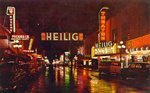
Heilig Theater, circa 1958. The theater was the Heilig, on Willamette Street between 6th and 7th, a venerable, balconied Vaudeville edifice, later a movie house, eventually among the many victims of urban renewal in the Seventies (the Hult Center occupies its former location).
The Western Union guy was J.A. “Mac” McKevitt, manager of the Eugene
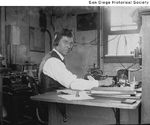
A telegraph operator.Western Union station. McKevitt started work in 1906, when the Western Union office was established, on what is now West Broadway, with one “lady operator” and a part-time messenger boy on his payroll. Starting in around 1915, all road games were reported via Morse code from the remote site to Eugene.
The contraption on the stage was a miniature football field, slightly inclined at
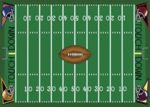
Something like this.the back for ease of visibility to the crowd, made of plywood. Above the field was suspended a small football, connected to a series of pulleys and strings that allowed an operator to move the ball back and forth. Western Union ran a telegraph line from the Broadway station to the Heilig, where McKevitt would set up his portable “ticker” backstage.
McKevitt would translate the dots and dashes received from the remote game transmitter into English, relay them to the guy with a megaphone, who would in turn announce the play by play results to the Heilig’s audience, while the boy running the pulleys would move the ball back and forth across the field, and another would track the score on a small scoreboard.
In a 1931 interview, McKevitt said one of his greatest thrills was in the 1917 Tournament of Roses football game, when Oregon defeated Penn by two touchdowns:
McKevitt took the results of that game play-by-play off the wire and gave them to the announcer at the Heilig theater. The house was packed, Eugene fans were standing in the aisles and clear back to the top of the balcony. The little gridiron was rigged up on stage, and the miniature football was being worked back and forth with the plays. “Mac”
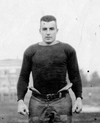
Shy Huntington.remembers getting the message and giving it a word at a time to the announcer: “HUNTINGTON …. MAKES …. TOUCHDOWN!” Pandemonium broke loose, and Mac couldn’t find out whether Oregon converted the [extra] point because the place was so full of noise that he couldn’t hear the ticker, even with his ear down against it. McKevitt was sitting on the stage, with the footlights turned on, and he said as he looked out over the glare of the lights, the theater looked like a giant fountain with hats, coats, sweaters, everything being thrown into the air.”
— Roy Craft, Eugene Register-Guard, 1931
***
In the mid-1920s, Jack Benefiel, graduate manager of the football team (the equivalent of today’s athletic director), upgraded the “broadcast” technology by purchasing a “grid-graph,” a vertical board equipped with electric lights, that showed the position of the players on the field. But the back end of the system was the same; McKevitt would receive the telegraph updates, communicate them to the grid-graph operator, and the lights would be changed to show the action.
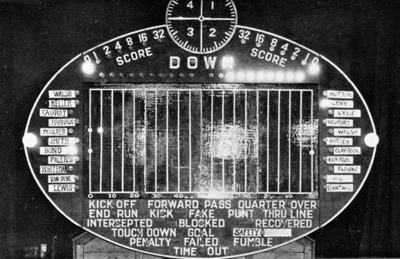
A “grid-graph” from the early 1920s. Note the 7-bit scoring system at the top. Presumably, games would never top 63 points.
Of course, the Human Element could occasionally intrude in an event interpreted by grid-graph, with farcical results:
When the Huskers opened their season against the University of Illinois, it was an historical game for several reasons. It was the first Nebraska game to be broadcast on the radio, and the first to be depicted on the Grid-graph. Of even greater importance, it featured the varsity debut of one of the footballs greatest heroes, ‘the Galloping Ghost’, ‘Red’ Grange.
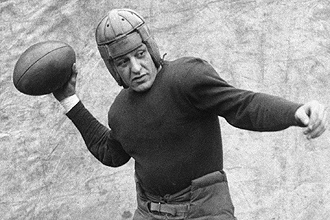
Red GrangeNebraska held its own for most of the game, but ended up losing 24 - 7. The performance of ‘Red’ Grange was too much to overcome. He scored three touchdowns, including a punt return. He showed more brilliant open field running after catching a pass, rambling for 50 yards and the score.
Back in Lincoln, Nebraska, the crowd at the Armory were the only ones to see the most spectacular play of the day. They were the only ones to see the play because it never really happened. The play was the result of confusion by the operators of the Grid-graph and the radio station. The play by play account of the game was being relayed to the Armory by a special wire from Western Union. The same account of the game was being shared by the radio station in its broadcast of the game.
The telegraph operator would type the information, and hand it to the operator of the Grid-graph . When he was done, another man would take the same card and phone the information to the radio station. Occasionally the Grid-graph operator would fall behind, and the dispatches would pile up.
On one occasion, the man relaying the information to the radio station eagerly snatched up the dispatch before the Grid-graph operator had a chance to post the information. The papers that were taken out of sequence contained the record of a touchdown. When it was discovered that a mistake had been made, the Grid-graph operators realized that their score was incorrect. They resolved the situation by showing the crowd a spectacular 70 yard run, by ‘Red’ Grange. A run that never really happened.
— “Watching Away Games Before TV,” Leather Helmets Illustrated
***
By the late 1920s, radio had come to any household that wanted it; all the major college games were broadcast, and the grid-graph technology, along with the theater dates, fell by the wayside (although the concept of packing a house for a transmitted event continued well into the late 20th century, with closed-circuit broadcasts of boxing matches; and of course the modern “sports bar” is essentially performing the same service, sans exclusivity).
Next time another off-the-cuff inanity by Craig James Brock Huard makes you want to throw your remote at the big screen, consider how far we’ve come in 95 years.
Then, go ahead and throw it.
Wisconsin and Oregon. Separated at birth?
December 23, 2011 Unlike Oregon’s other recent Big Game opponents, teams with significant winning traditions and great pedigrees, the 2012 Rose Bowl will see the Ducks playing a team that’s in many respects a mirror image of itself.
Not in the style of play or physical attributes – the differences between Oregon and Wisconsin on the field are well documented, and a subject of great debate on other sites – but in their histories, and what they’ve put their fans through over the years.
If Oregon’s dividing line between The Suffering and success is 1994, Wisconsin’s equivalent Year of Demarcation is 1993, when the Badgers, in Barry Alvarez’s third season, broke a 30 year Rose Bowl drought and a string of eight straight losing seasons.
As close chronologically as the teams respective Years of Demarcation are, their respective records during the preceding Decades of Suckitude, and subsequent Ages of Enlightenment, are also eerily similar:
|
Period |
Wins |
Losses |
Ties |
Pct |
|
|
Oregon |
1965 – 1993 |
126 |
186 |
7 |
.406 |
|
Wisconsin |
1964 – 1992 |
114 |
192 |
9 |
.376 |
|
Oregon |
1994 – 2011 |
158 |
68 |
0 |
.699 |
|
Wisconsin |
1993 – 2011 |
166 |
69 |
4 |
.703 |
It would be difficult to intentionally manipulate the performance of two teams to generate records this similar over almost identical periods.
There are so many similarities in Oregon and Wisconsin’s histories that it’s almost easier to find the differences. (There, one can start with Camp Randall Stadium, with almost twice the capacity of Autzen, and the legendary fanaticism of football fans in Wisconsin. Fan support for the Badgers is so solid that in 1968, when the team was suffering its second consecutive winless season, the stadium was still filled to 54% of capacity. Only during the Don Morton era did attendance regularly dip below 40,000 – a major factor in his termination; he was replaced by Barry Alvarez in 1990. By contrast, during the years of abject apathy for the Ducks, in the mid-70s, the stadium was regularly half-empty, or worse… and Oregon has never gone winless once, never mind twice.)
Now, those similarities…
Separated at birth? |
Oregon |
Wisconsin |
|
Modern Rose Bowl drought |
37 years (1958 – 1995) |
31 years (1963 – 1994) |
|
9+ win seasons, 1945 - 1993 |
1 (1948) |
None |
|
9+ win seasons since 1993 |
11 |
10 |
|
Bowl appearances, |
6 |
3 |
|
Bowl appearances, 1964– 2012 |
19 |
20 |
|
Losing seasons, 1964 – 1993 |
20 |
24 |
|
Losing seasons since 1994 |
1 |
2 |
|
Longest losing streak |
15 games |
24 games |
|
Ten horrible but representative pre-1994 losses (* = home) |
1972: 68-3, Oklahoma 1974: 61-7, Nebraska 1974: 66-0, Washington 1975: 5-0, San Jose St * 1976: 53-0, USC * 1976: 46-0, UCLA 1977: 54-0, Washington * 1982: 10-4, Fresno St * 1983: 21-15, Pacific * 1985: 63-0, Nebraska |
1968: 0-20, Utah St * 1974: 52-7, Ohio St 1975: 41-7, Kansas * 1977: 56-0, Michigan 1978: 55-2, Michigan St 1978: 42-0, Michigan * 1988: 24-14, Western Michigan * 1988: 62-14, Michigan * 1989: 51-3, Miami FL * 1990: 24-18, Temple * |
|
Swan Dive Season |
1988 (6-1 start; 0-5 finish) |
1977 (5-0 start; 0-6 finish) |
|
Immovable Force Offense |
1982 (103 points in 11 games) |
1968 (86 points in 10 games) |
|
Irresistible Object Defense |
1977 (allowed 377 in 11 games) |
1969 (allowed 349 in 10 games) |
|
Minor bowl appearances that felt major to the teams at the time, considering |
1989 Independence (W) 1990 Freedom (L) 1992 Independence (L) |
1981 Garden State (L) 1982 Independence (W) 1984 Hall of Fame Classic (L) |
|
Brief period of optimism |
1979-1980 (winning seasons with John Becker as offensive coordinator) |
1981-1984 (three bowls in four years under head coach Dave McClain) |
|
Setback after brief period of optimism |
Probation, 1980-1982 |
Sudden death of head coach (Dave McClain died of heart attack during offseason, 1985) |
|
Coach named Don who was fired after 3 years of blowout losses and declining attendance, who won a national championship in a lower division |
Don Read (fired 1977; won D 1-AA title at Montana in 1995 ) |
Don Morton (fired 1989; won D-II title at North Dakota State in 1983) |
|
Athletic Director who replaced a Hall of Fame legend (and damn near ruined everything) |
Norv Ritchey |
Ade Sponberg |
|
Athletic Director who saved the program |
Bill Byrne (1982-1992) |
Pat Richter (1990-2006) |
|
AP poll appearances, 1964 - 1992 |
13 of 361 polls (.036) |
9 of 361 polls (.025) |
|
Anomaly |
Celebrated 1993 win over Michigan by hospitalizing 73 fans after stampede to field |
|
|
Signature win that finally ended The Suffering (or whatever Wiscy calls it) |
||
|
Established team as national power in his only Division 1 head coaching job, then became Athletic Director |
Mike Bellotti |
Barry Alvarez |
|
Quarterback who threw for a zillion yards and set multiple Rose Bowl offensive records, despite losing |
Danny O’Neil (1995) |
Ron Vander Kelen (1963) |
|
Longtime, bitter rival that has been utterly dominated for years |
Washington |
Minnesota |
1 Oregon was ineligible for bowl games other than the Rose Bowl from 1916-1958 and 1963-1974, but was granted an exception in 1948 season to play in the Cotton Bowl. From 1959-1963 Oregon played as a “Western Independent” and was eligible for other bowl appearances. As a member of the Big Ten, Wisconsin was ineligible to appear in any bowl game other than the Rose Bowl until 1977, when the conference relaxed its postseason rules.
Time For Yet Another Titanic Battle with UCLA.
November 27, 2011 Okay, the title is a bait and switch. I’m among many not expecting this weekend’s inaugural Pac-12 Championship Game to be much more than a tune-up for the Ducks and a swan song for UCLA’s coach. But it’s a good excuse to look back at some of the donnybrooks these two teams have played over the years.
The Bruins own a 36-28 edge in the series – no ties, interesting – but the advantage is largely due to a 34-year period, from 1945 to 1979, when UCLA won 20 times and Oregon just three. 27 of the 64 games have been decided by eight points or less, and of those one-possession games, UCLA has won 14 times and Oregon 13. Outside that postwar era, the series has been very competitive.
There have been a lot of barnburners in this series. Herewith, a synopsis of six of the best games:
HB Elmer Brown (The Great)1932: UCLA 12, Oregon 7 – Despite being outplayed the entire game, Prink Callison’s Webfoots seemingly had this one in the bag, leading 7-6 with two minutes left, and driving deep into Bruin territory. But the only pass Oregon threw all day went from reserve back Elmer Brown straight to UCLA’s Mike Frankovitch. Oops! Still, the Bruins were backed up to their own seven yard line. Fifteen seconds remained. Then, a dime-store novel finish, in the words of the Oregonian’s L.H. Gregory:
(Yes, that was our own Bill Bowerman, failing to wrap up on the tackle.)Frankovitch, the strong-armed quarterback of the UCLA clan, faded back across his own goal line. Down the east sideline darted Ransom Livesay, the number 14 on his once-yellow jersey all but obliterated by mud. Frankovitch heaved the ball. It soared toward the running Livesay as Bowerman from the defensive right halfback position and Elmer Brown, the Oregon safety, also converged on the falling leather. Livesay turned at the 25 yard line just as Brown, leaping to bat down the pass, missed it entirely. That put him out of the play. Livesay reached out, clutching and then hugging the slippery ball to his side, just as Bowerman dived at him for the tackle. Bowerman had his arms around Livesay, but with a lunge, the UCLA back had spun loose and then, splashing down the sideline far ahead of all possible pursuit, sloshed 75 yards through the mud to the winning touchdown.
HB/DB Jay Graybeal1938: Oregon 14, UCLA 12 – In a Hayward Field game that Register-Guard sports editor Dick Strite, in typically reserved fashion, called “the most spectacular game seen behind the drab wooden walls of the University stadium as long as memory recalls”, the Webfoots traded touchdowns with the Bruins, but made their extra points while UCLA missed theirs. A fourth quarter touchdown pass from Jay Graybeal to Ted Gebhardt won the game for Oregon. The game wasn’t decided until Graybeal, the “Pendleton Jackrabbit,” intercepted the final pass from UCLA’s QB Chuck Fennenbock in the end zone as time expired. The home team, using the “Oliver’s Twist” 6-2-2-1 box defense of new HC Tex Oliver, held UCLA’s great Kenny Washington to 33 yards on 13 carries. There was brief Rose Bowl enthusiasm, as the game put Oregon at 2-0 in conference play, but as with the rest of Oliver’s Webfoot squads, the 1938 team finished below .500.
Charley Tourville1958: UCLA 7, Oregon 3 – It was to be Oregon’s last game played in Los Angeles until, well, as far as anyone knew, forever; the Pacific Coast Conference was dissolving at season’s end, and the new “Big Five” conference that replaced it had no room for the Ducks. And on this November day, it appeared the goal was to give the fans nothing to remember either team by.
The Ducks had all season deployed a tenacious D (allowing just six points per game, with three shutouts in seven contests) but an offensive O (three shutouts and just ten points per game). Both traits were in demonstration against the Bruins: After 55 minutes of play, the score at the LA Coliseum was 0-0, in what Al Wolf of the LA Times called “a dreary mish-mash of futility, frustration and foolishness.” Then, all hell broke loose. Oregon kicker John Clarke hit a 17 yard field goal to give the Ducks a lead. A short kickoff gave the Bruins great field position, at their 45; and two long passes from UCLA QB Kirk Wilson to end Phil Parslow put UCLA in position for a nine yard dive by fullback Ray Smith for the touchdown. Three minutes remained, sufficient time for a final drive, but Oregon’s Charley Tourville fumbled the ensuing kickoff return, which was recovered by Jim Steffen of the Bruins – his third takeaway of the game – and UCLA ran out the clock.
It was Oregon’s fourth loss by seven or fewer points in 1958; they would lose one more like that, in what must have seemed a microcosm of the season, 2-0 at Miami.
QB/P Tom Blanchard1970: Oregon 41, UCLA 40 – The talented but paper-thin Ducks, who at 2-2 had one of the nation’s top passing attacks but were otherwise performing to expectations, met a team of Bruins in the LA Coliseum that expected to contend for a Rose Bowl berth after missing out by two points in 1969. Although they held a 21-18 halftime lead, the leaky defense of the Ducks resulted in a three TD second-half onslaught by UCLA’s quarterback Dennis Dummit. With 4:12 left in the game, the form chart was holding, UCLA leading 40-21, and most of the fans had begun making their way to the exits.
Rolling the dice, Oregon HC Jerry Frei replaced his brilliant but erratic sophomore QB, Dan Fouts, with the veteran but oft-injured punter and reserve QB Tom Blanchard. And things began to click. Blanchard, who hadn’t taken a snap at QB in three games, moved the team downfield in three plays and 33 seconds, hitting Bobby Moore for the TD; 40-28. UCLA coach Tommy Prothro, with under four minutes remaining, figured the game was still in hand. He swapped little-used reserve QB Jim Nader for Dummit. Nader fumbled three plays later, the Ducks recovered on the UCLA 40; two plays after that, Blanchard tossed a bomb to Moore for another score. 40-35. 2:24 left, Ken Woody’s onside kick was recovered by Don Frease for Oregon.
On third down Blanchard threw a fade to Leland Glass that appeared to be caught by UCLA DB Jerry Jaso at the 11, but officials said Glass and Jaso had attained simultaneous possession; first down at the 10. But Blanchard had played the previous series with a separated shoulder – earned while blocking for Moore on a sweep — and had to come out. Fouts returned, but after a Moore run Fouts was sacked on a roll-out for a ten yard loss. 3rd and 14 with a minute left. Finally, TE Greg Specht flashed open over the middle, Fouts hit him on the numbers, and the Ducks led by a point. After a failed two-point attempt, the Bruins got as far as midfield before the re-inserted Dummit’s final pass was picked off by safety Bill Brauner. Ball game, and in the locker room Frei was wiping away tears of joy. “That was the greatest comeback I’ve ever been around,” he said. “Tonight’s game has to top anything that has ever happened to me.”
P Mike Preacher1984: Oregon 20, UCLA 18 – The 6-2 Bruins, in Rose Bowl contention as usual, seemed to have everything going for them after staging a furious fourth quarter comeback at Autzen. Trailing 17-3, UCLA QB Steve Bono had thrown two touchdown passes, and the Ducks could only counter with a Matt McLeod field goal. Oregon was on a four-game losing streak and had seen star wideout Lew Barnes limp off the field with a knee injury. And the Bruins had one of the country’s best kickers in John Lee, who seemingly never missed. Here we go again was the likely collective thought of the fans in attendance. After a two point conversion, UCLA was within two with 3:21 left. Oregon couldn’t run out the clock, but punter Mike Preacher hit one of the best kicks of his career, a 48 yard howitzer that bit like it was hit with a sand wedge, downed at the UCLA 13. The Bruins had less than a minute left and no timeouts, and – after tailback Gaston Green was held inches short of the marker on fourth down – no chances left. Oregon wound up 6-5 for the year, the first winning season since 1980; UCLA was 9-3 – the Oregon loss cost them the Rose Bowl, but they beat Miami in the Fiesta Bowl.
TE Vince Ferry carries RB Sean Burwell after winning catch (AP)1990: Oregon 28, UCLA 24 – Bill Musgrave’s last pass at Autzen Stadium, a 16 yard rifle shot to Vince Ferry with 2:01 remaining, gave Oregon the only lead it saw in the entire game. Oregon OC Mike Bellotti: “He threw his tightest spiral and had his best velocity on the most crucial play of the game… We talked all week about performing at crunch time, and I guess we pretty much did.” The win gave Oregon its first unbeaten home record at Autzen since its opening in 1967. The Ducks had trailed 24-13 with less than ten minutes left, but a Juan Shedrick plunge after a 72 yard drive, along with a two point conversion by Ngalu Kelemeni, put them within three, setting up Musgrave’s heroics. Ferry was a walk-on at tight end, who was only activated because Jeff Thomason had broken his ankle, and the catch was only the fourth of his Oregon career.
A crowd estimated at a thousand happy students took 15 minutes dislodging the east goal post from its mooring, passing it up and over the stadium fence and across the Autzen footbridge to the campus; it was eventually dumped on the front porch of the Administration Bvilding.