November 9, 1940 – Oregon 18, UCLA 0
 October 8, 2012
 ;) Tex Oliver was apparently worried enough about UCLA halfback Jack Robinson to lock the reporters out of practice.
Tex Oliver was apparently worried enough about UCLA halfback Jack Robinson to lock the reporters out of practice.
On the surface, he had good reason. This was the brilliant athlete, who we now know as “the” Jackie Robinson, the MLB Hall of Famer whose number is officially retired on every team in baseball, who broke the infamous color barrier in 1947.
In 1940, Robinson wasn’t yet a legend, but he was on his way. A four sport star at UCLA – his older brother Mack had been a star track athlete at Oregon in the mid 1930s, after winning a silver medal in the Olympics (Oregon had recruited Jackie for football but didn’t have a good enough scholarship package available) – Robinson had torn up the Webfoots in 1939. Teaming with future College HOF QB Kenny Washington on a 66 yard TD pass, then later intercepting a pass by Bob Smith and following that with a 82 yard run on a reverse, the final was Jackie Robinson 12, Other UCLA Players 4, Oregon 6. UCLA didn’t lose in 1939, going 6-0-4 for the best record in team history, as Robinson averaged over 12 yards per carry.
;) Thus, Robinson, aka the “Black Blur,” the “Midnight Express,” the “Colored Flash” — it would have apparently killed the racist writers of the time to come up with an original sobriquet — was a marked man in 1940, clearly an outstanding player and one of the fastest backs in the nation. The problem for UCLA was that the Bruins didn’t have much of a team to back him up in 1940. The brilliant Washington had graduated, and the Bruins had no players capable of picking up the slack when Robinson was inevitably double teamed, face-guarded, blanketed, hornswoggled, clotheslined and otherwise neutralized. For all his promise, Robinson had been held in check by every team he’d faced in his junior season. By the time UCLA made it to Hayward Field on a rainy November morning, the Bruins were mired in a six game losing streak, were averaging less than six points a game, and Robinson had only two touchdowns to his name.
Thus, Robinson, aka the “Black Blur,” the “Midnight Express,” the “Colored Flash” — it would have apparently killed the racist writers of the time to come up with an original sobriquet — was a marked man in 1940, clearly an outstanding player and one of the fastest backs in the nation. The problem for UCLA was that the Bruins didn’t have much of a team to back him up in 1940. The brilliant Washington had graduated, and the Bruins had no players capable of picking up the slack when Robinson was inevitably double teamed, face-guarded, blanketed, hornswoggled, clotheslined and otherwise neutralized. For all his promise, Robinson had been held in check by every team he’d faced in his junior season. By the time UCLA made it to Hayward Field on a rainy November morning, the Bruins were mired in a six game losing streak, were averaging less than six points a game, and Robinson had only two touchdowns to his name.
Still, the hype followed him up the coast:
“Jackie Robinson, the ‘Midnight Express’ of the UCLA Bruins, will be prepared to demonstrate the speed and elusiveness which won him the rank of America’s most dangerous backfield threat when Babe Horrell’s Bruins invade Hayward Field on Saturday afternoon…”
— Dick Strite, Eugene Register-Guard, 7 November 1940
But for this game, it was all hype. UCLA’s offensive woes continued on the muddy Hayward turf; the Bruins only managed to run off 22 plays, resulting in one first down, 28 net yards rushing, and 13 yards passing – 41 yards of total offense. They never advanced past the Oregon 32 yard line. There is no consistency to statistics kept during the prewar era, but it’s safe to say this was one of the great defensive performances in Oregon pre-war history.
The Webfoots doubtless took great advantage of a typically horrible November Hayward Field condition. This was UCLA’s only game outside California, and head coach Horrell said afterwards that many of his players had never played a game in the rain. And his starting QB Ned Mathews had suffered a knee injury in the second quarter, forcing Robinson to move from halfback to quarterback – something he wasn’t very good at (he went 2-11-1 for all 13 of UCLA’s passing yards). On UCLA’s last drive he was sacked for a twelve yard loss, slamming the ball halfway into the muck in disgust.
“Though the Oregons kept Robinson cooped, the Negro boy nevertheless kept them in a constant sweat lest he break away… He was frightfully dangerous even on the shoe-deep wet turf whenever he ran with that ball. Attempts to tackle him about the legs were pure wasted efforts. Again and again he’d flip out of tacklers’ hands, even when seemingly hopelessly cooped up – to stop him, they had to grab him above the waist, or still better around the Negro boy’s neck and headlock him out of bounds.
“Robinson’s yardage wasn’t the real measure of his performance – he simply couldn’t break away, and was rushed so ferociously that his passes didn’t work. But when he finally left the game late in the fourth period, the customers not only heaved sighs of relief but gave him the tribute of a cheer.”
— L. H. Gregory, The Oregonian, 10 November 1940
Evidence that Robinson was the whole game story: In the Oregonian’s game report, no Oregon player is mentioned by name until the seventh paragraph on page three, well after Robinson’s entire day had been described. In the Register-Guard, the locals got credit in paragraph six, again after copious descriptions of the bottling of Jackie Robinson.
Evidence that Robinson is still the whole game story 62 years later: we are just now getting around to mentioning that Oregon’s stars of the game were QB John “Buck” Berry, dual-threat HB/P Len Isberg and SE Frank Boyd, who led the Webfoots to 304 yards of total offense.
;) Tex OliverUCLA returned to SoCal for the rest of its games, but won only once in 1940. Robinson didn’t come close to his 1939 numbers, and didn’t make the AP All-Coast team, not even the third unit, but was named 2nd team UPI All-Coast. Oregon, as always under Oliver a numbingly mediocre team, ended the season 4-4-1; the shutout of UCLA was one of three on the season, a feat that has only been surpassed twice (under Len Casanova the Ducks pitched four shutouts in 1955 and 1958; Oregon hasn’t had more than two shutouts in a season since then).
Tex OliverUCLA returned to SoCal for the rest of its games, but won only once in 1940. Robinson didn’t come close to his 1939 numbers, and didn’t make the AP All-Coast team, not even the third unit, but was named 2nd team UPI All-Coast. Oregon, as always under Oliver a numbingly mediocre team, ended the season 4-4-1; the shutout of UCLA was one of three on the season, a feat that has only been surpassed twice (under Len Casanova the Ducks pitched four shutouts in 1955 and 1958; Oregon hasn’t had more than two shutouts in a season since then).
Program Notes –
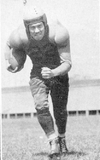 Leonard IsbergHalfback Len Isberg still holds 4th place on Oregon’s all-time punting list with a net average of 42.8 yards, and holds the unofficial record for longest punt – 80 yards, from the Oregon 11 to the Washington 9 in the 1940 game at Multnomah Stadium. Isberg was drafted in round 19 of the 1941 NFL draft (#175 overall), but eschewed pro football to work in advertising.
 - Page Three has a helpful bit of instruction – How to Read The Electric Sports Timer (“The long hand is the second hand; the short hand indicates minutes left to play in the quarter.”).
- As usual in this era, the biggest ads are for cigarette makers, with four full-color pages.. and one little quarter-page for Old Golds on page 20.
- “Oregon Webfoots Drink KNOX GELATINE” – “Knox definitely reduces tiredness.” Apparently Knox Gelatine was the 1940 equivalent of Red Bull.
- Team managers Frank Meek and Bob Engelke are featured in a page 21 story. A journalism major, Meek enlisted in the Army Air Corps after graduating in 1941 and rose through the ranks, retiring in 1972 as a Colonel and commandant of the Defense Information School in Indianapolis; he then spent 17 years as general manager of the Indianapolis PBS affiliate, WFYI. Engelke was captain of the golf team; that’s all I know about him.
- A bit of unfortunate verbiage, considering the time period, in a story about homecoming festivities on page 22: “Booming into full flame, the giant torch lit up the holocaust. It was a conflagration that thrust back the darkness and that kindled even hotter flames of spirit and enthusiasm in the breasts of the shouters.”
- UCLA’s experience at Hayward Field’s mudpit in 1940 probably led to a future reluctance to play games in Oregon — between 1941 and 1958, the teams played 11 times in Los Angeles and just four in Oregon. The regular series died in 1959 with the disintegration of the old PAC, and Oregon didn’t play the Bruins for 11 years, finally renewing the series at Autzen in 1969.
;)
;)
;)
;)
;)
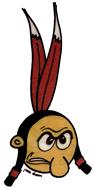 dignity; that year, the Stanford administration responded to their petition by unilaterally declaring, to its eternal credit, that “any and all Stanford University use of the Indian Symbol should be immediately disavowed and permanently stopped.” Ever since, there have been periodic efforts by nimrod fraternity brothers and alumni to resurrect a “wild-eyed, big-nosed, tomahawk-chopping savage” as the public face of Stanford athletics, as recently as 2006. (
;)
